
Key takeaways
-
Range bag essentials do three jobs: gear that keeps you safe, gear that feeds the gun, and gear that gets lead off you before you touch a steering wheel.
-
Double up on ear protection for shooting range work. NIOSH sets an impulse-noise ceiling of 140 dB per shot, and one protector rarely gets you under it.
-
Shooting glasses need the Z87+ marking, not just Z87. The plus is the high-impact test - a quarter-inch steel ball at 150 feet per second.
-
The lead dust mask is the item almost every list omits. OSHA's action level for airborne lead is 30 µg/m³ and its PEL is 50 µg/m³. Range air blows past both.
-
Hygiene is half the kit. Wipes, dedicated range clothes and soap beat any filter if you're still eating a sandwich with lead on your hands.
The core kit: ear pro, eye pro, ammo, targets, cleaning basics
Start with shooting range safety equipment you wear, because the rest of the bag exists to serve it.
Ear protection for shooting range sessions
A .223 rifle runs about 155–165 dB at the muzzle and a 9mm pistol about 160 dB. NIOSH's guidance is blunt: impulse noise should not exceed 140 dB at the ear, and one protector is often not enough margin. Its own derating rule for estimating real attenuation is to knock 25% off the labelled NRR for earmuffs and 50% off formable earplugs. That 33 NRR pair of muffs is closer to 24 in the real world.
So we double up. Foam plugs first, muffs over the top - NIOSH notes dual protection adds roughly 5 to 10 dB of extra attenuation. Electronic muffs with compression circuitry are the practical pick: you keep conversation and range commands, and the loud stuff gets clipped.
Shooting glasses
Buy for the marking, not the tint. ANSI/ISEA Z87.1 is the eyewear standard, and Z87+ means it passed the high-velocity impact test. Plain Z87 does not. Polycarbonate lenses are the norm for a reason.
You need them on for more than shooting: brass bouncing off a lane divider, a ruptured case, a squib, cleaning solvent splashing off a bore brush. The NSSF also flags eye protection for disassembly and cleaning, not just live fire.
Fit matters more than lens colour. If the frames sit low and there's a gap at the brow, nothing is being protected.
Ammunition
Bring more than you plan to shoot. A 250-round session eats a 200-round box plus whatever you re-shoot to fix a flinch. Keep rounds in factory boxes or a labelled ammo pouch - loose rounds in the bottom of a bag pick up grit and range dust, and you'll lose the count.
Targets and target accessories
-
Splatter or reactive targets - you'll see hits without a spotting scope.
-
Pasters, masking tape and a stapler. Ranges run out of tape. Bring your own.
-
A small cardboard backer for staples when the range's carriers are chewed up.
-
A shot timer if you're training rather than plinking.
Cleaning basics
A bore snake, a rod, patches, a brush, CLP, a cleaning mat and nitrile gloves. The mat isn't decoration - it's the tray that stops solvent and lead residue landing on your car's boot floor. Dedicated cleaning gloves stay in the bag and never touch food.
The essentials most shooters forget
These are the items you only miss once, and then never again.
First aid. A proper individual first aid kit: trauma dressing, haemostatic gauze, a CAT-style tourniquet, chest seals, gloves. Not a box of plasters. Ranges are loud, distractions happen, and the nearest ambulance is often 20 minutes out.
Tools. A multitool, a set of hex keys for optic and mount screws, a small sight-adjustment tool, a borelight, and a strip of blue threadlocker. Half of a bad range day is a loose scope base.
Spare batteries. Electronic muffs run on AAA, red dots and chronographs on CR2032, timers and lights on whatever the manual says. Carry two of each in a labelled zip bag and rotate them once a year.
Weather gear. A packable rain shell, a hat, shooting gloves, sunscreen and insect repellent. Outdoor bays are wind tunnels in winter and frying pans in July.
Water and food. A litre minimum, more in summer. Eating is fine - the moment you're done shooting and your hands are clean. More on that below.
A chamber flag and a small cleaning cloth for the bag itself. Your bag will get dusty, and that dust is lead-bearing.

Respiratory protection: the item missing from every range bag list
Go and read ten articles on gun range bag essentials. All ten will cover ear pro, eye pro, ammo and targets. None of them will tell you what to breathe through, and none will tell you what to do with your hands afterwards.
Lead at the firing line isn't a theory
Centre-fire primers use lead styphnate. When the striker hits, it detonates at over 2,000 °C, the lead vaporises, and it condenses into a metal fume fine enough to sit in the 0.1–2 µm band - squarely in the respirable range that reaches the deep lung rather than stopping in your nose.
OSHA's fact sheet on indoor firing ranges (Publication 3772) puts the action level at 30 µg/m³ and the permissible exposure limit at 50 µg/m³, both as 8-hour averages. Air sampling at ranges routinely exceeds them; it does not take a long session to get there. A NIOSH case study of law-enforcement trainees recorded mean blood lead levels rising from 6.5 µg/dL before training to 50.4 µg/dL after indoor range time.
Two takeaways for a bag:
-
The plume comes back at you. When a round strikes the backstop, settled lead re-aerosolises and drifts into the lanes. Standing on the line is the exposure, not just shooting.
-
Cleaning and brass pickup are worse. Sweeping, picking up cases and clearing trays lift the finest fraction of what already landed. That's when NIOSH's range-cleaning guidance points to N100/R100/P100 filtration, escalating to supplied air for heavy cleaning.
Why a range bag should carry a mask
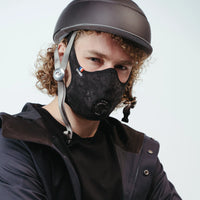
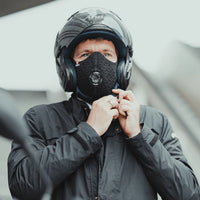
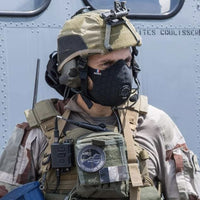
Because the alternative is a 40-minute drive home breathing through a nose full of lead-bearing dust, and because "I'll just hold my breath" fails the moment a string runs long. A half-mask with P100 filters, or a sealed nanofibre mask rated below the 0.3 µm mark, weighs almost nothing and takes one pocket.
Filter classes that matter for lead: N100, R100, P100 (99.97%) or FFP3 (≥99%). N95 is a floor, not a target.
Filter storage and care
Lead dust loading is real, and a filter that clogs makes breathing harder, which makes you adjust the mask, which breaks the seal.
-
Store the mask in a sealed hard case or zip bag, never loose in the main compartment next to your ammo.
-
Write the in-service date on the filter body in marker.
-
Replace when breathing resistance rises noticeably, when the filter is damaged, or on the maker's schedule - whichever comes first.
-
Wipe the outside of the mask with a damp cloth after use, and keep it away from food, water bottles and bedding.
-
If you have facial hair inside the seal zone, fix the seal or shave. NIOSH-controlled studies show leakage rising 50 to 1,000 times.
If you want the full comparison of filter classes and what the certification numbers actually test, we've written that up separately.
Post-session hygiene kit
This is the half of the bag nobody photographs, and the half that actually moves your blood lead level.
-
Lead decontamination wipes. A pack of wipes lives in the outer pocket. Wipe hands, forearms and face before you leave the bay. Cold water and soap work; wipes work when there's no sink.
-
Hand cleaning before eating. No food, drink, gum or cigarettes until your hands are washed. Hand-to-mouth transfer is one of the main documented pathways for recreational shooters, and it's entirely self-inflicted.
-
Dedicated range clothes. A cheap long-sleeve shirt and trousers that never go in the family laundry. Change out of them before you sit in the car - NIOSH's take-home contamination guidance is explicit that lead rides home on clothes, shoes, hair and bags.
-
Dedicated range shoes in a plastic bag, not the trainers you wear into your kitchen.
-
A lidded brass container. Spent cases are the dirtiest thing in the bag. Bags, not pockets.
-
Keeping lead out of the car. Rubber boot liner, a cheap seat cover, and a HEPA vacuum for the interior - a normal shop vac redistributes lead dust instead of capturing it. Wash range clothes separately on their own cycle, never with kids' clothes.
How to pack a range bag
Weight distribution
Heavy on the bottom, centred, as close to your spine as the straps let you. Two hundred rounds of 9mm weighs about 5 lb; four boxes plus a bottle of water moves the bag's centre of gravity fast. Ammo goes in the bottom centre compartment, first aid on the outside where a stranger can reach it, water in a side pocket you can grab without opening the main body.
Organisation
Pouches beat piles. One pouch per job: ear pro, eye pro, tools, spare batteries, hygiene, cleaning. Everything in a pouch can be found by feel in the dark. Anything loose becomes a two-minute rummage at a cold outdoor bay.
Quick-access layout
-
Outer pocket: first aid kit and eye pro - the two things you want without opening anything.
-
Top of the main compartment: ear pro and the mask.
-
Main body: ammo, targets, tape, stapler.
-
Bottom/back: tools, cleaning kit, spare batteries.
-
Side pocket: water.
Don't overpack
A 40 lb bag gets left in the car. If you're refreshing your kit, here's a practical way to check it: pack it, then ask what to bring to the shooting range for the next two sessions. Anything you didn't touch in two trips comes out. Range bag essentials are the things that survived contact with reality.

Printable range bag checklist
Print this, tick it before you leave the house, keep a copy in the bag. If you'd rather have a one-page PDF, this is the same list we use at the club.
|
Category |
Item |
Why it earns its place |
|
Ear protection |
Muffs + foam plugs (dual) |
NIOSH derates NRR; dual adds 5–10 dB |
|
Ear protection |
Spare plugs in the car |
Someone always forgets theirs |
|
Eye protection |
Z87+ shooting glasses |
High-impact rating, worn for cleaning too |
|
Respiratory |
P100/FFP3 lead dust mask |
Firing line and brass pickup |
|
Respiratory |
Sealed filter case + spare filter |
Loaded filters and seal damage |
|
Ammunition |
20% more than the plan |
Reshoots, function tests |
|
Ammunition |
Labelled ammo pouch / factory boxes |
Keeps grit and count under control |
|
Targets |
Splatter targets + backer card |
Instant feedback without a scope |
|
Targets |
Pasters, masking tape, stapler |
Range tape is always out |
|
Training |
Shot timer + spare battery |
Sessions without data are guesswork |
|
Cleaning |
Bore snake, rod, patches, CLP |
Post-session, before storage |
|
Cleaning |
Cleaning mat + nitrile gloves |
Keeps lead off the car and hands |
|
Tools |
Multitool, hex keys, sight tool |
Loose mounts end range days |
|
Tools |
Blue threadlocker |
One small tube, one big save |
|
Spares |
CR2032 + AAA batteries |
Optics, muffs, timers |
|
Weather |
Rain shell, hat, gloves, SPF |
Bays are wind tunnels or frying pans |
|
Hygiene |
Lead decontamination wipes |
Hands, forearms, face before the car |
|
Hygiene |
Dedicated range clothes + shoes |
Take-home contamination |
|
Hygiene |
Lidded brass container |
The dirtiest thing you carry |
|
Comfort |
1 L water + snack |
Hydration, and eating only after washing |
|
Admin |
Club card, ID, logbook, chamber flag |
Range check-in without drama |
FAQ
What should a beginner bring to the shooting range? Ear pro (plugs plus muffs), Z87+ shooting glasses, ammunition in a factory box, targets and tape, water, and a photo ID for check-in. Rent or borrow a firearm for the first few sessions and add the rest of the kit once you know what you actually reach for.
Do I really need to double up on hearing protection? For centre-fire inside a bay, yes. NIOSH derates a labelled 33 NRR to roughly 24 for muffs, and rifles and pistols peak around 155–165 dB at the muzzle. Plugs and muffs together add another 5–10 dB, and that's the margin you want over a session of 100+ rounds.
Are cheap shooting glasses good enough? Only if they're marked Z87+. Cheap non-rated sunglasses are worse than nothing in a way people don't expect - they can shatter and send fragments toward the eye. Look for the Z87+ stamp on the frame or lens.
Do I need a mask at an outdoor range? Exposure is lower outdoors, but the exposure spike at the firing line and on the backstop still happens, and most outdoor ranges have covered firing points where air stagnates. If you shoot indoors at all, own one mask and carry it every time. Then the habit is already there.
How often should I replace the filter? Not on a calendar. Replace when breathing resistance rises, when the filter shows damage or heavy loading, and at the manufacturer's interval. Write the install date on the filter so you're not guessing.
Can I wash my range clothes with the family laundry? No. NIOSH's take-home contamination guidance says normal household laundry is not adequate for lead-contaminated clothing. Wash range clothes separately, on their own, and dry them separately.
Sources
-
OSHA - Lead Hazards: Protecting Workers at Indoor Firing Ranges (OSHA 3772)
-
CDC NIOSH - Reducing Exposure to Lead at Indoor Firing Ranges (Pub. 2009-136)
-
CDC NIOSH - Information for Workers: Lead take-home contamination
-
CDC NIOSH - Noise and hearing loss prevention: personal protective equipment
-
CDC PPE-Info - ANSI/ISEA Z87.1-2020, eye and face protection standard
-
EPA - Best management practices for lead at outdoor shooting ranges
-
CDC MMWR - Elevated blood lead levels among target shooters and range workers, 2002–2013
-
Review - Blood lead levels among recreational shooters (PMC5379568)
-
Study - Airborne lead particle size distribution at indoor firing ranges (PMC10400594)


