
Key Takeaways
-
Lead is the primary hazard at any indoor range - primer ignition generates sub-micron lead fume (PM0.3 and below) that bypasses most standard filters and deposits deep in lung tissue.
-
Ventilation alone is not enough. NIOSH health hazard evaluations have documented airborne lead concentrations of 0.229–0.330 mg/m³ at firing points in compliant civilian indoor ranges - well above the OSHA PEL of 50 µg/m³ under 29 CFR 1910.1025.
-
Your respirator goes on before you open the range door. Lead contamination starts the moment you enter the environment, not when you pull the trigger.
-
Full decontamination after every session is non-negotiable - skin, hair, clothing, gear, and car interior are all secondary transfer vectors.
-
Your risk tier depends on your profile. A casual outdoor shooter and a daily range officer face fundamentally different exposure levels and need different precaution stacks.
Before You Enter the Range
Most shooters run through a mental checklist of firearm safety rules before a session. Almost none run a contamination checklist. That's the gap. Here's the priority order.
1. Respirator - Put It On First
Before your hearing protection. Before your eye pro. Before you open the range door.
Lead fume from primer ignition consists of particles in the PM0.3 range and below - ultrafine aerosols that stay airborne for extended periods and penetrate deep into the lungs. Standard surgical masks do nothing. Even a basic N95 is insufficient for this particle size and concentration.
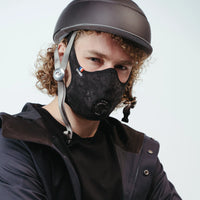
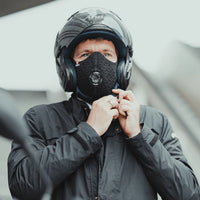
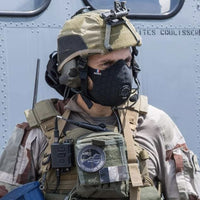
The floor is P100-rated respiratory protection (NIOSH-designated, ≥99.97% filtration at 0.3 µm). R-PUR's nanofiltration technology goes further: PM0.05 filtration, which captures particles ten times smaller than what P100/FFP3/N100 standards test against, plus gas-phase filtration for VOCs and lead fumes that particle filters alone miss. At a range where a single 70-minute session can put you above the OSHA PEL, that margin matters.
Put it on in the parking lot. Not at your lane.

2. Hearing Protection - Double Up for High-Caliber Sessions
Gunfire peaks at 140–165 dB SPL depending on caliber and enclosure. A single shot exceeds NIOSH's 85 dB recommended limit by a factor that makes time-weighting irrelevant.
-
NRR 25+ earmuffs as the baseline
-
Foam plugs underneath for high-caliber or high-volume sessions
The combined NRR calculation: take the higher NRR rating and add 5 dB. NRR 33 muffs + foam plugs = an effective combined NRR of 38. That's the math, and it's the standard OSHA guidance for dual protection.
3. Eye Protection - ANSI Z87.1+ Only
Standard prescription glasses or sunglasses do not qualify. You need ANSI Z87.1+ rated eye protection - the standard that certifies impact resistance against high-velocity projectile fragments. Look for the Z87+ marking on the lens or frame.
4. Clothing - Close-Weave Fabric, Dedicated Range Clothes
Fleece, velcro, and open-weave fabrics trap lead particles and are nearly impossible to fully decontaminate. Wear dedicated range clothes in close-weave cotton or synthetic fabric. These stay in a sealed bag until they're washed - separately from your household laundry.
No loose clothing that could catch on equipment. No open-toe footwear. And critically: no fleece. It's a lead-particle magnet.
At the Range - During Your Session
You know the four rules. This section isn't about them. It's about contamination discipline - the behavioral layer that most shooters skip entirely.
Session Duration Limits
NIOSH health hazard evaluations have documented breathing-zone lead concentrations of 0.229–0.330 mg/m³ at firing points in civilian indoor ranges - that's up to 6–7 times the OSHA PEL of 50 µg/m³. These are compliant ranges with functioning ventilation.
A 70-minute indoor session under these conditions can push cumulative exposure above the OSHA permissible limit for an 8-hour workday. Shorter sessions mean lower cumulative exposure. If you're shooting indoors weekly or more, session length is a lever worth pulling.
Ventilation Awareness
Range ventilation systems move air from the shooter toward the target - laminar flow, front to back. Stand with the airflow at your back, not your face. If you're at a lane where the airflow feels like it's coming toward you, move lanes or speak to range staff.
The ventilation system reduces ambient room concentration. It does not filter the air at your breathing zone during active firing. That's your respirator's job, and it's why the two are not interchangeable.
No Hand-to-Face Contact
This is the most violated rule at ranges. Lead ingestion via hand-to-mouth contact is a primary exposure route - and it bypasses your respirator entirely. Don't touch your face. Don't eat. Don't drink. Not at the range, not in the parking lot before you've washed your hands.
Phone Hygiene
Your phone is a lead transfer vector. Every time you handle it at the range with contaminated hands, you deposit lead on the screen. Every time you then touch your face while using it later, you ingest that lead. Minimize phone handling during your session. If you must use it, wipe it down with a lead-removal wipe before it goes back in your pocket.
After Shooting - Decontamination Protocol
Lead dust follows you home. The decontamination sequence matters - do it out of order and you're just redistributing contamination.
Step 1: Hands and Face - Before You Touch Anything Else
Wash hands and face before touching your car keys, your phone, or your face. Use lead-removal soap - D-Lead or Hygenall LeadOff. Standard hand soap does not reliably break down lead compounds; these formulations are specifically designed to chelate and lift lead from skin.
If no sink is available at the range, lead-removal wipes are an acceptable field substitute.
Step 2: Gear Wipedown - Before It Goes in the Car
Wipe down your firearm, range bag, hearing protection, and eye pro with a damp cloth or lead-removal wipe before loading them into your vehicle. Your car interior is a secondary contamination environment - especially if children ride in it.
Step 3: Clothing - Remove Before Getting In the Car
If possible, remove your range clothes before getting in your vehicle. Bag them separately in a sealed bag. Do not shake them out - that re-aerosolizes lead dust.
Wash range clothes in a separate laundry load from household clothing. Lead particles on fabric transfer to other garments and to anyone who handles them.
Step 4: Shower and Hair Wash at Home
Your scalp traps fine particles effectively. Shower as soon as you get home and wash your hair thoroughly. This isn't optional hygiene - it's the final step of the decontamination protocol.
For a complete step-by-step breakdown of every surface, product recommendation, and timing sequence, the dedicated shooting range decontamination protocol guide covers the full post-session routine in detail.
Checklist by Shooter Profile
Not every shooter faces the same exposure level. Here's how precaution tiers scale with frequency and environment.
|
Profile |
Frequency |
Environment |
Key Risks |
Precaution Tier |
|
Casual / Recreational |
1–2×/month |
Outdoor, mostly |
Lower ambient lead; wind dispersion helps |
Baseline: P100+ respirator, full decon after every session, dedicated range clothes |
|
Competitive / High-Frequency |
Weekly or more |
Indoor, primarily |
Cumulative lead exposure; elevated BLL risk over time |
Enhanced: strict session duration limits, blood lead level (BLL) monitoring every 6 months, full decon every session without exception |
|
Range Officer / Instructor |
Daily |
Indoor |
Occupational exposure; OSHA 29 CFR 1910.1025 applies |
Occupational: mandatory BLL testing under OSHA lead standard, respiratory protection is PPE not optional, medical surveillance required |
Range officers and instructors are not recreational shooters from a regulatory standpoint. OSHA's lead standard (29 CFR 1910.1025) applies to their workplace, which means mandatory exposure monitoring, medical surveillance, and employer-provided respiratory protection. If you work at a range and your employer isn't running a compliant lead program, that's an OSHA violation - not a gray area.
For a detailed breakdown of what OSHA 1910.1025 requires for indoor range operators and staff, the shooting range ventilation and OSHA compliance guide covers the regulatory framework in full.
The Gear That Actually Matters
Respirator
P100/N100/FFP3 is the minimum. These standards certify ≥99.97% filtration at 0.3 µm - which is already above what most masks achieve, but still leaves a gap for the sub-0.3 µm lead fume particles generated by primer ignition.
R-PUR's nanofiltration technology filters to PM0.05 - capturing particles ten times smaller than the P100 test particle - and adds gas-phase filtration for VOCs and lead fumes that particle filters alone cannot address. For indoor shooting range use, that combination is the most complete respiratory protection currently available in a wearable mask format.
This is the one piece of gear you cannot compromise on. Everything else in this checklist assumes your breathing zone is protected.

Hearing Protection
-
NRR 25+ earmuffs as the baseline for any range session
-
Foam earplugs underneath for high-caliber or high-volume sessions (combined NRR = higher NRR + 5)
-
Electronic earmuffs with active noise limiting are useful for communication and situational awareness without sacrificing protection
Eye Protection
ANSI Z87.1+ only. Look for the Z87+ stamp on the lens or frame. Standard glasses - including prescription lenses - do not meet this standard and will not protect against high-velocity fragment impacts.
Lead-Removal Soap
D-Lead or Hygenall LeadOff - not standard hand soap. The chemistry matters: lead-removal formulations are designed to chelate lead compounds and lift them from skin. Standard soap moves contamination around; it doesn't reliably remove it.
Keep a travel-size bottle in your range bag. Use it before you touch anything else after a session.
For a full breakdown of gear selection, layering strategy, and product-specific recommendations, the shooting range safety equipment guide covers mask, hearing, and eye protection in detail.
FAQ
Do I need a mask if the range has good ventilation?
Yes. Range ventilation reduces ambient airborne lead concentration across the room - it is not personal protective equipment. NIOSH health hazard evaluations have documented shooter exposures above the OSHA PEL at ranges with functional, compliant ventilation systems. The ventilation system and your respirator serve different functions; neither replaces the other. Your breathing zone during active firing is not covered by the HVAC system.
How long can I shoot indoors before lead exposure becomes a risk?
The risk starts immediately. The question is cumulative dose. NIOSH HHE data shows that a single 70-minute indoor session at a compliant range can push breathing-zone exposure above the OSHA PEL of 50 µg/m³ (8-hour TWA). Without a P100-or-better respirator, you're accumulating exposure from the first shot. With proper respiratory protection, session duration becomes less critical - but shorter sessions still mean lower cumulative risk.
What's the first thing to do after leaving the range?
Wash your hands and face with lead-removal soap before touching anything else - your car keys, your phone, your face. This single step prevents the majority of secondary lead transfer. Everything else in the decontamination protocol follows from there.
Is outdoor shooting safer for lead exposure?
Meaningfully, yes. Open-air dispersion significantly reduces ambient airborne lead compared to an enclosed range. That said, outdoor shooting is not exposure-free: primer ignition still generates lead fume at the muzzle, and wind direction can concentrate that plume toward the shooter. Respiratory protection is still the correct call, especially for high-frequency outdoor shooters.
Can I reuse a disposable mask at the range?
A disposable N95 or P100 half-mask can be reused within its rated service life, but check the manufacturer's guidance. More importantly: a disposable mask that has been used at a range is itself a contaminated item. Handle it carefully when removing it, store it in a sealed bag, and wash your hands immediately after. If the mask is visibly damaged, wet, or has been used for multiple long sessions, replace it.
Do range officers face higher lead exposure than shooters?
Yes - significantly higher. Instructors and range officers are present for multiple sessions per day, every day, in the highest-concentration zone of the range. NIOSH data from Polish indoor ranges found instructor breathing-zone exposure averaged 0.37 mg/m³ - higher than the 0.23 mg/m³ measured at shooting stalls, and more than seven times the OSHA PEL. For range staff, respiratory protection is not optional equipment. It's mandated PPE under OSHA 29 CFR 1910.1025, and blood lead level monitoring is a regulatory requirement, not a personal choice. For guidance on what BLL results mean and when to act, the blood lead level testing and monitoring guide covers current CDC and NIOSH reference values in detail.
Useful Sources
-
OSHA 29 CFR 1910.1025 - Lead Standard (PEL 50 µg/m³, medical surveillance, respiratory protection requirements): osha.gov/laws-regs/regulations/standardnumber/1910/1910.1025
-
NIOSH Alert 2009-136 - Preventing Lead and Noise Exposures at Indoor Firing Ranges: cdc.gov/niosh/docs/2009-136
-
CDC/ATSDR - Lead Toxicity: Routes of Exposure and Health Effects: archive.cdc.gov/www_atsdr_cdc_gov/csem/leadtoxicity
-
PMC - Airborne Lead Concentrations at Civilian Indoor Shooting Ranges (peer-reviewed): pmc.ncbi.nlm.nih.gov/articles/PMC12185985
-
PMC - Lead Exposure in Indoor Shooting Ranges: A Systematic Review: pmc.ncbi.nlm.nih.gov/articles/PMC5379568
-
EPA - Best Management Practices for Lead at Outdoor Shooting Ranges: epa.gov/lead/best-management-practices-lead-outdoor-shooting-ranges

